Trump Accounts for Kids Are Now Live. Here's Everything Parents Need to Know
· Time
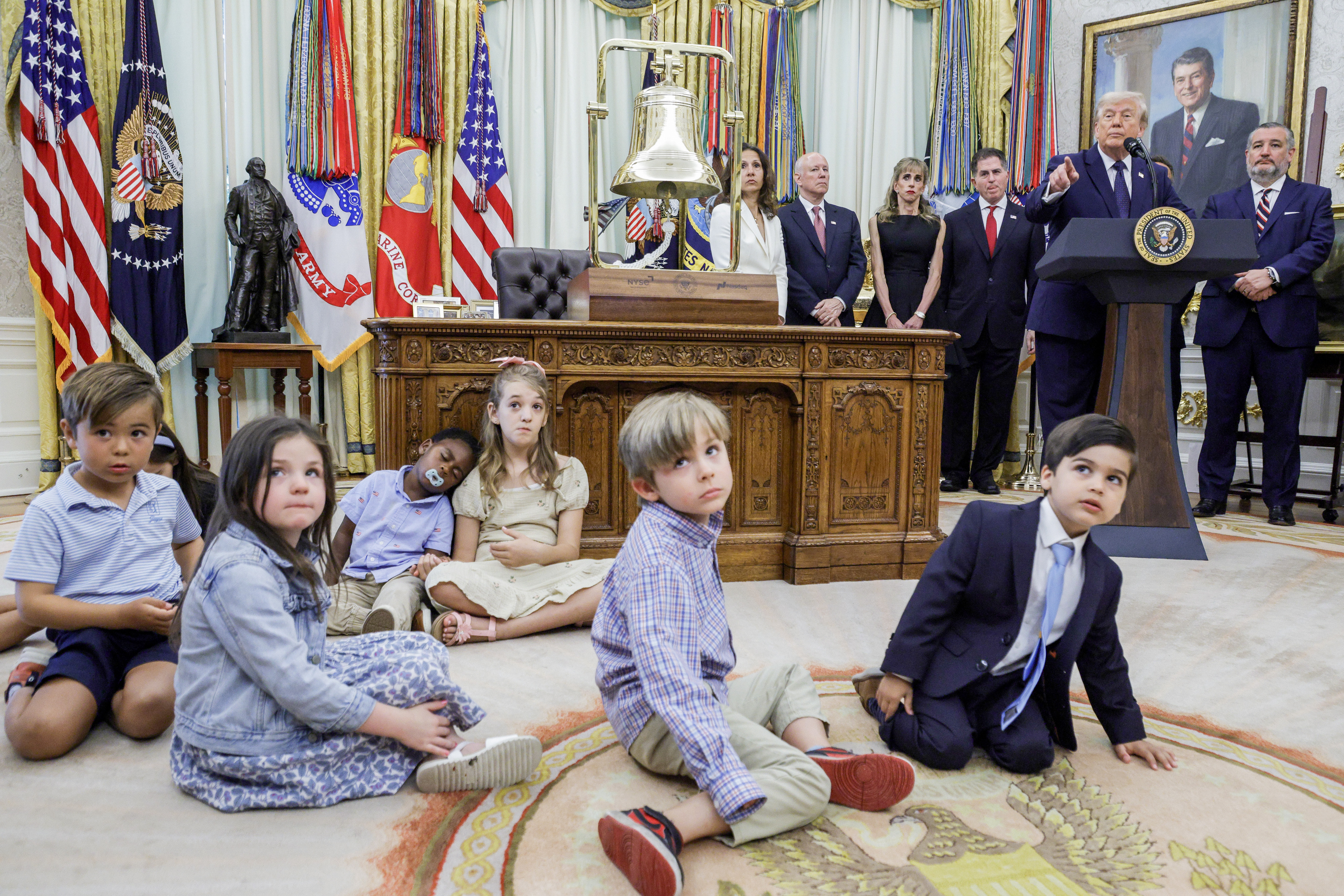
President Donald Trump on Monday rang the opening bell of the New York Stock Exchange to mark the first trading day of the newly-launched “Trump Accounts” for children.
Visit biznow.biz for more information.
"With the ringing of the opening bell for the stock market, those accounts will now begin to grow right along with our booming economy, and I really believe we’re going to have the biggest boom of all,” Trump said as he rang the bell remotely from the Oval Office.
“Between individual contributions and the seed funds, $800 million in new capital will be invested in the stock market for America's children this week,” he added.
The highly-anticipated initiative, officially launched on July 4 as part of the Trump Administration’s 250th celebrations, will see eligible newborns receive an account with a one-time $1,000 government-funded payment.
U.S. Treasury Secretary Scott Bessent said the families of 6 million children have already signed up, with 1.4 million of those qualifying for the seed money.
Trump was joined in the Oval Office by Michael and Susan Dell, who committed $6.25 billion towards funding the program in December.
With American families curious as to how they might benefit from the newly-launched Trump Accounts, here’s what you need to know:
What is a Trump Account?
According to government legislation, Trump Accounts are a new form of a traditional investment retirement account (IRA) that have been created for the benefit of children, with special rules applying.
Once opened, an eligible account will automatically receive a one-time, tax-free $1,000 contribution from the federal government. The funds, plus any further contributions, will be automatically invested in an index fund that tracks the S&P 500, which itself tracks the performance of the top 500 U.S. companies trading on the stock market.
Contributions to Trump Accounts will be invested into the State Street SPDR Portfolio S&P 500 ETF, according to the Treasury. This will remain as the default index for funds to be invested in over the coming months, but the Treasury said that it expects to make other investment options available for parents and guardians in the near future.
The accounts are listed in the child’s name, with parents acting as the sole custodian until the child is 18.
Funds within an account cannot be accessed until the child turns 18, when they can then be withdrawn for qualified expenses such as education or the purchase of a first home.
The Trump Administration has confirmed that it will allow philanthropist contributions towards the program through public company stock. Contributors can transfer stock to the Treasury, which will then invest the funds into accounts in line with the donator’s guidelines.
“By accepting contributions of publicly traded stock, [the] Treasury is creating a practical pathway for large-scale private giving to support the next generation,” said Bessent on July 2.
Does your baby qualify for a $1000 Trump Account—and what do you need to do?
Babies that are U.S. citizens born between Jan. 1, 2025, and Dec. 31, 2028 are eligible to receive the one-time government seed contribution of $1,000 in their account. This timeframe falls within Trump’s second term in office.
In order to set up a Trump Account for eligible children, parents or guardians must submit an IRS Form 4547. This can be done via the Trump Accounts app, when filing taxes, or through the IRS website, Individual Online Accounts.
A maximum of $5,000 overall can be contributed to each account annually from parents, other family and friends, and the employers of parents and guardians. Most contributions will be taxed, but employers can provide up to $2,500 a year, tax-free (per employee, not per child). State and local governments can also make tax-free contributions.
Companies including Goldman Sachs, BlackRock, and Nasdaq, have pledged to match the federal seed contribution of $1,000 for eligible accounts of children of employees.
Semi-conductor manufacturer Micron has also announced an employee matching benefit for contributions up to $1,000 per child under 18. Additionally, Micron said it will provide a community benefit of a one-time $250 seed deposit for children with Trump Accounts where the company operates in Idaho, New York, Virginia, California, Colorado, Minnesota, and Texas.
“This massive investment will help millions of American children and families get a strong start in life, and give them real financial security,” said Trump in response to the contribution. “My policies are working, and working ‘big.’”
How much could a Trump Account accumulate?
Without any investment beyond the initial $1,000, the Administration estimates a Trump Account account would be valued at $6,000 when the child turns 18, based on historical S&P 500 averages. With the maximum annual contribution of $5,000, accounts could see a value of up to $271,000 after 18 years.
“Trump Accounts level the playing field by allowing every parent to invest in their children’s future, not just wealthy families with trust funds,” a Treasury spokesperson told TIME on Monday.
Experts have, however, raised concerns that the initiative could disproportionately benefit well-off Americans.
“The program may be open to every child, but its benefits will flow overwhelmingly to families with the means to contribute thousands of dollars a year,” argued Stanford economists Neale Mahoney and Adam Shaw in an article for TIME. "What could have been a leveling tool instead risks becoming a widening wedge between the haves and the have-nots."
Are older children eligible for payments?
Older children born before Jan. 1, 2025, will not be eligible for the one-off $1,000 government payment, but can still open up a Trump Account.
To qualify, the child must be a U.S. citizen with a social security number, and the account must be opened before the end of the year in which the child reaches the age of 18.
Children under the age of 10 may also benefit from contributions offered by high-profile philanthropists.
In December 2025, the Dells pledged $6.25 billion for the accounts, giving an additional $250 to the first 25 million accounts registered for children aged 10 and under, living in ZIP codes with a median household income of under $150,000 annually.
Ray Dalio, investor and the founder of Bridgewater Associates, and his wife Barbara also committed to providing $250 to 300,000 children under 10 in Connecticut who live in ZIP codes where the median income is less than $150,000.