Supreme Court Eyes Pan-India Building Safety Scrutiny After Satya Niketan Collapse
· Free Press Journal
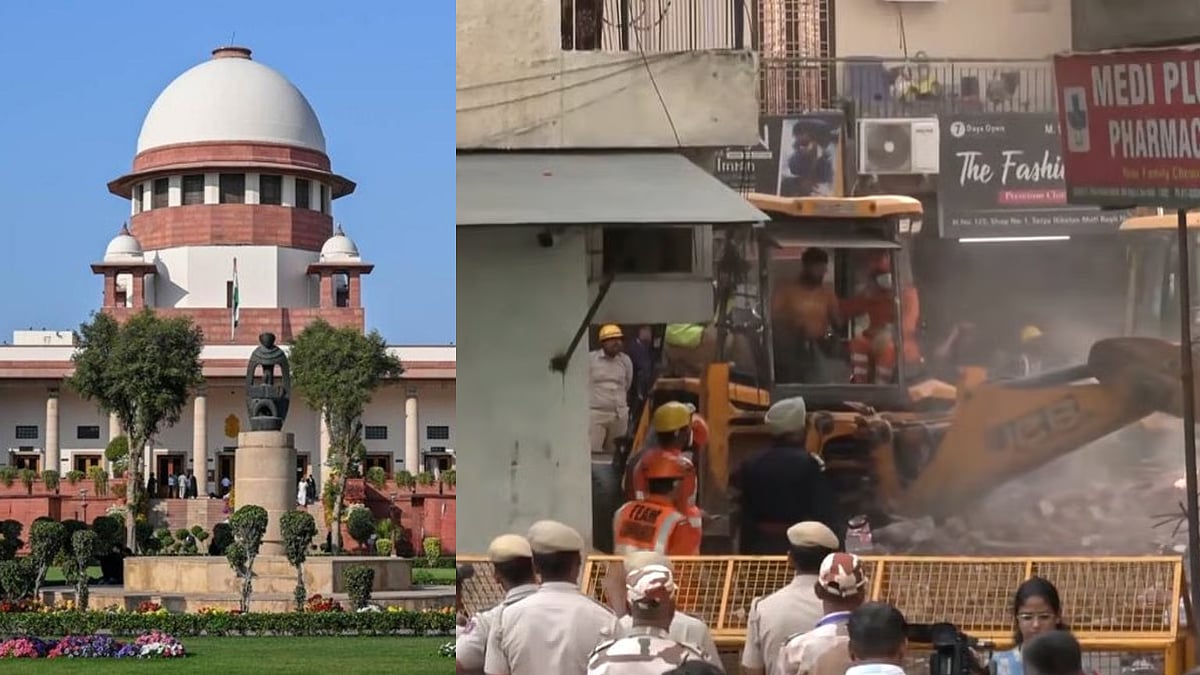
The Supreme Court on Tuesday said it was considering examining building safety issues on a pan-India basis following the collapse of a building being used as a boys’ paying guest (PG) accommodation in Delhi’s Satya Niketan, which left seven people dead.
A Bench of Justices Ahsanuddin Amanullah and R Mahadevan indicated that it may also transfer to itself a public interest litigation (PIL) pending before the Delhi High Court over the Satya Niketan collapse. The Supreme Court will take up the matter on Friday.
Visit chinesewhispers.club for more information.
Court Signals Wider Scrutiny
“We already have something in mind. It has to be on a pan India basis. We may get it (petition before Delhi High Court) transferred here. We will take it day after tomorrow,” the Court said.
The development came after Senior Advocate Ajit Kumar Sinha, the court-appointed Amicus Curiae in a broader case concerning building violations, sought an early hearing and placed the September 6 incident before the Supreme Court through a status report.
Sinha sought directions for a time-bound inspection and safety audit of PG accommodations, private hostels and similar student housing facilities in and around colleges and universities across Delhi.
“In view of the recent tragic incident, it is a very serious issue. We have inspected, completed and the last inspection is today at 2:30 pm,” Sinha told the Court , Live Law and Bar & Bench report.
Delhi HC Case May Move To SC
Solicitor General Tushar Mehta informed the Bench that the Delhi High Court had already taken up a PIL concerning the incident and passed directions.
“It is a horrific incident. Our hearts go for children and parents. A PIL has been filed in the Delhi High Court. We can file a transfer petition but I am pointing out the order that was passed,” Mehta said.
Mehta also submitted that the matter had been taken up “in right earnest” and pointed out that officials found responsible had been suspended.
Justice Amanullah, however, noted that the issues raised before the High Court overlapped with the Supreme Court’s ongoing proceedings on building violations.
“This has been taken in right earnest but it is overlapping. We will take it day after tomorrow and then probably we may make the transfer here. We already have something in mind. It will have to be pan India basis,” Justice Amanullah said.
The possibility of bringing the proceedings under one court could give the issue a wider focus, particularly as the Supreme Court is already examining violations of building and land-use regulations beyond the Satya Niketan incident.
Seven Dead, 12 Rescued
The building at Property No P-14, Satya Niketan, South-West Delhi, collapsed at around 1.30 pm on September 6. According to the Amicus Curiae’s status report, the property measured approximately 55 square yards and comprised a basement and four floors above the ground floor.
It was being used as a boys’ PG accommodation under the name Hostel Daze. Seven people died, while at least 12 were rescued and taken to hospitals, including the All India Institute of Medical Sciences (AIIMS) Trauma Centre and Safdarjung Hospital.
The precise cause of the collapse remains under investigation. Preliminary material before the Amicus Curiae indicates that construction-related work was being carried out in or around the basement. There were also reports of waterlogging in the basement immediately before the collapse.
Delhi Police registered a first information report (FIR) at South Campus Police Station under Sections 105, 290 and 125 of the Bharatiya Nyaya Sanhita, 2023. The building owner, identified as Hari Om Bansal, was reportedly arrested in Rajasthan on September 7.
Safety Audit Sought For Student Housing
Sinha pointed out that Satya Niketan was not covered by an inspection exercise previously ordered by the Supreme Court.
In July, the Court had expressed concern over civic authorities’ failure to act against unauthorised and potentially dangerous structures following the Saket building collapse and the Malviya Nagar hotel fire.
Through its July 9 order, the Court constituted a committee to inspect buildings in Lajpat Nagar, Saket and Malviya Nagar. The team included Indian Institute of Technology (IIT) Delhi professors, Municipal Corporation of Delhi (MCD) officials and the Amicus Curiae.
The inspection was completed on September 3. According to the status report, the committee found some buildings in Saidulajab, Saket and Lajpat Nagar to be in a precarious and unsafe condition. Its report is yet to be placed before the Court.
The Court had earlier sought action-taken reports from the authorities and warned that officials could be held personally responsible for failing to act against building violations.
Sinha has now proposed extending the inspection exercise to PG accommodations, private hostels and similar student housing establishments across Delhi.
The proposed exercise would examine sanctioned building plans, actual construction and the number of floors, basement construction and alterations, permissible land use, structural safety, fire-safety compliance, means of entry and exit, and whether premises are dangerous or in a ruinous condition.
The demand for broader scrutiny assumes significance because such accommodation houses students who may have little ability to assess whether a building complies with structural and fire-safety requirements. The Satya Niketan tragedy has consequently put the spotlight not only on an individual property but also on how effectively existing building rules are enforced.
Satya Niketan Saw 2022 Collapse Too
The status report also noted that Satya Niketan witnessed another building collapse in April 2022, when two people died and four others were injured.
According to the report, another fatal collapse in the same locality raises concerns about the existing mechanism for inspecting buildings, identifying dangerous structures and enforcing building bye-laws.
The recurrence makes questions over enforcement difficult to ignore. Rules and inspection mechanisms can protect residents only when violations are identified and acted upon before a structure becomes dangerous.
MCD Suspends Five Officers
The MCD has suspended five South Zone officers in connection with the latest incident.
It has also ordered the demolition of adjoining Property No P-13, Satya Niketan, after finding it to be in a dangerous condition. The demolition order was issued on September 6 under Section 348 read with Section 491 of the Delhi Municipal Corporation Act, 1957.
Separately, the Delhi High Court on Monday directed the MCD to conduct a high-level inquiry into whether the collapsed Satya Niketan building had valid construction permissions and identify officials responsible for any lapses.
The High Court also directed the civic body to inspect all PG hostels under its jurisdiction within one week and report whether the buildings housing them had been constructed with the required permissions and whether there were violations of those permissions or building bye-laws.
It further asked the MCD to state whether statutory or executive regulations exist to regulate PG hostels in Delhi.
Morning Walkers Panic After Leopard Appears at Kota's CV Garden, Rescued After 4 HoursUnsafe PGs Under Lens
The Delhi High Court expressed concern over the proliferation of unsafe PG accommodations and the shortage of institutional hostel facilities for students. It observed that PG owners often undertake construction in violation of sanctioned plans.
The PIL before the High Court is now likely to be transferred to the Supreme Court.
The Supreme Court’s ongoing proceedings concern widespread violations of building bye-laws and land-use regulations. On March 25, 2026, the Court took note of such violations and observed that construction was frequently being undertaken in breach of applicable norms, including in prohibited areas.
It directed that the issue be monitored on a pan-India basis.
The Satya Niketan collapse has now added urgency to that scrutiny. With seven lives lost and an earlier fatal collapse in the same locality already on record, the proceedings raise a larger question for civic authorities: whether building-safety enforcement is happening early enough to prevent tragedies rather than only after lives have been lost.